
Inline measurement technology from SensoTech combines sonic velocity, conductivity and temperature to continuously determine acid and iron salt concentrations — for targeted acid dosing, stable pickling bath quality and fewer delayed laboratory analyses.
In steel pickling lines, acid and iron salt concentrations change continuously: while free acid is consumed during the process, the proportion of dissolved metal salts increases. For stable pickling performance, it is therefore not sufficient to monitor only a single process parameter. With LiquiSonic® 40, SensoTech measures the relevant concentrations directly in the process and in real time. The continuous measured values provide a reliable basis for fresh acid dosing, bath control, regeneration decisions and quality assurance.
Acid and iron salts change simultaneously
Pickling baths are used after hot rolling and in other areas of metal processing to remove scale and oxides and to specifically clean, modify or passivate surfaces. Depending on the material and process, acids such as hydrochloric acid (HCl), sulfuric acid (H2SO4), nitric acid (HNO3) and hydrofluoric acid (HF) are used. During pickling, the concentration of free acid decreases, while the concentration of dissolved metal salts or iron salts increases. Both parameters influence the actual pickling strength.
If the acid strength is too low or acid is dosed too late, the desired surface quality may not be achieved. Pickling that is too aggressive or too long, on the other hand, can unnecessarily attack the material and surface. Delayed laboratory analyses only reflect a single point in time and can only make dynamic changes in the running process visible with a time delay.
Two measured variables for determining acid and iron salt
LiquiSonic® 40 combines high-precision sonic velocity measurement with conductivity and process temperature. This enables multicomponent systems such as HCl, iron and water to be clearly evaluated. Sonic velocity and conductivity react differently to changes in acid and salt concentration; temperature is recorded simultaneously and included in the evaluation. This allows acid and iron salt to be determined separately.
For typical hydrochloric acid pickling processes, SensoTech specifies measuring ranges of 0 to 250 g/l free HCl, 0 to 140 g/l Fe and 60 to 95 °C. Other pickling acids and measuring ranges can be adapted to the specific application. The measured values are updated continuously and can be transmitted to the process control system.
Less blind operation between sampling and laboratory results
The key difference compared with purely offline-based process control lies in the continuous availability of measured values. Changes in bath chemistry, inaccurate acid dosing or increasing iron salt content become visible during the running process. This allows fresh acid to be dosed more precisely before deviations become noticeable in surface quality or downstream process steps. At the same time, the need for manual sampling and routine laboratory analyses is reduced.
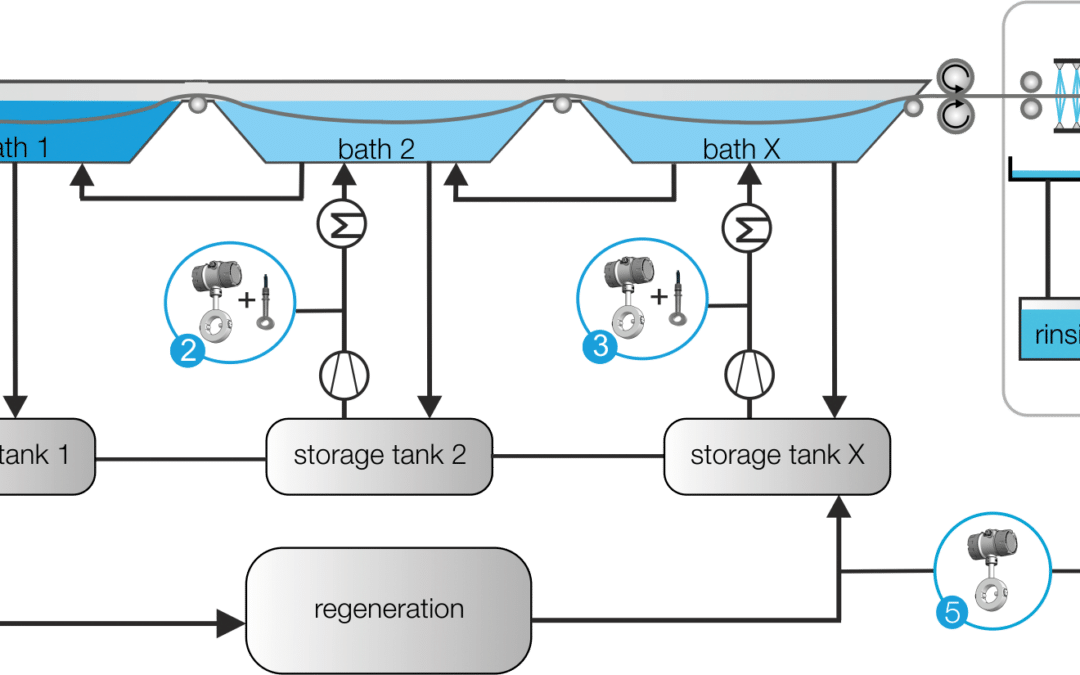
In addition to the pickling bath itself, the measurement technology can also be used in the rinse bath, in the fresh acid feed and around acid regeneration. This makes it possible not only to monitor bath quality, but also to make chemical process control along the line more transparent.
Integration in pipelines, bypasses or directly in the pickling tank
LiquiSonic® sensors can be installed in transport lines or bypasses. Corrosion-resistant materials and coatings are available for aggressive media. In classic 3-component measurement, SensoTech combines, for example, a Halar-coated ultrasonic sensor with a PEEK-coated conductivity sensor.
For applications where direct measurement in the pickling tank is advantageous, a special pickling tank technology has also been developed. In this setup, a tantalum sonic velocity sensor with a PEEK extension and a PEEK conductivity sensor in a customer-specific length can be inserted directly into the tank. The solution is designed for continuous 24/7 measurement of pickling bath parameters and has already been used at various customer sites.
Practical example at ArcelorMittal: Inline measurement directly in the pickling tank
A documented application at ArcelorMittal Belgium in Ghent shows how continuous pickling bath monitoring performs under real production conditions. The case study attached to this press release describes the use of LiquiSonic® in an HCl steel pickling line, where hydrochloric acid concentration and dissolved iron content are directly relevant to process stability, acid consumption, and surface quality. The process conditions place high demands on the measurement technology: strong hydrochloric acid, high temperatures, increasing concentrations of dissolved iron, and turbulent flow make reliable continuous measurement particularly challenging. Conventional methods often rely on manual sampling and time-delayed laboratory analysis. Acid concentrations that are too low or too high can lead to under-pickling or over-pickling, increased acid consumption, and unstable surface quality. ArcelorMittal therefore chose a LiquiSonic® 40 measuring system for the combined inline determination of HCl and iron concentrations. The system combines sonic velocity and conductivity measurement. One particular feature of the application is the direct installation of the sensors in the pickling tank, eliminating the need for a bypass. To meet the demanding installation conditions, SensoTech adapted the sensor design and developed extended sensors for use in highly corrosive acid tanks. Following successful testing, the solution was implemented in several pickling lines and tanks. This provides concentration data directly from the pickling tank and in real time. Continuous process visibility supports faster responses to changes, reduces the need for manual sampling, and provides a reliable basis for controlling acid dosing and acid recovery. At the same time, inline monitoring supports consistent product quality and improves transparency regarding the actual condition of the pickling bath. Customer feedback also confirms the practical benefits. According to the case study, the Process Engineering team at ArcelorMittal Ghent considers the system reliable even under demanding process conditions. The solution contributes to faster reaction times, more stable process control, and improved overall line efficiency. The adapted sensor solution is also designed for maintenance-free operation under normal operating conditions.
The attached case study, “High-Precision Inline Monitoring for Pickling Lines and Pickling Tank Technology – ArcelorMittal Belgium,” provides further details on the initial situation, sensor installation, measurement technology used, and the benefits achieved in operation.
Direct benefits for steelworks and plant manufacturers
Inline monitoring is aimed at operators of steel and stainless steel pickling lines, service centers and strip processors as well as plant manufacturers and OEMs. In new plants, the measurement technology can be integrated directly into the process and automation architecture; in existing lines, retrofit solutions are possible in pipelines, bypasses or tanks. The benefits include traceable pickling bath quality, faster response to deviations, more demand-based acid dosing and reduced dependence on delayed laboratory values.
Webinar on inline monitoring in steel pickling lines
SensoTech will present further insights into inline monitoring of steel pickling processes in a dedicated webinar on September 15 and 16, 2026. Participants will learn how continuous measurement of acid and iron salt concentrations supports stable bath quality, more precise acid dosing and faster process decisions in modern pickling lines.
Https://www.sensotech.com/en/inline-pickling-bath-monitoring/